
Key Takeaways
- Poon Hill covers 50 to 55 km over 4 to 5 days at 3,210 meters maximum, costing $280 to $410 total ; ideal for beginners, families, and trekkers with limited vacation time.
- The Annapurna Circuit stretches 160 to 230 km over 12 to 21 days, crossing Thorong La Pass at 5,416 meters and costing $820 to $1,513 ; delivering 5 cultural zones and 360-degree mountain panoramas unavailable on shorter treks.
- Altitude sickness risk remains minimal on Poon Hill (below 3,500m) but affects 30% to 40% of circuit trekkers near Thorong La Pass, requiring Diamox medication and 2 to 3 acclimatization days in Manang.
- Combining both treks into a 16 to 26 day itinerary costs $1,000 to $1,900 total and uses Poon Hill as pre-acclimatization for the circuit’s high-altitude crossing.
Table of Contents
Poon Hill or Annapurna Circuit choosing between these 2 treks depends on available time, fitness level, and budget. Poon Hill covers 50 to 55 km over 4 to 5 days at a maximum altitude of 3,210 meters costing $200 to $400 total. The Annapurna Circuit stretches 160 to 230 km over 12 to 21 days, crossing Thorong La at 5,416 meters and costing $600 to $1,500 total.
Poon Hill or Annapurna Circuit? Quick Comparison at a Glance
| Factor | Poon Hill Trek | Annapurna Circuit |
| Duration | 3-5 days | 12-21 days |
| Distance | 50-55 km | 160-230 km |
| Max altitude | 3,210m | 5,416m |
| Difficulty | Easy-moderate | Moderate-difficult |
| Total cost | $200-400 | $600-1,500 |
| Daily cost | $40-80 | $50-75 |
| Permits | $50 (ACAP + TIMS) | $50 (ACAP + TIMS) |
| Altitude sickness risk | Minimal (below 3,500m) | High (Thorong La 5,416m) |
| Best for | Beginners, short vacations | Experienced, cultural immersion |
| Teahouse quality | High throughout | Varies by elevation |
| Cultural zones | 1 (Gurung) | 5 (Hindu to Tibetan) |
Both treks operate within the Annapurna Conservation Area covering 7,629 square kilometers. Understanding all the route options available across the Annapurna region helps trekkers compare Poon Hill or Annapurna Circuit against other alternatives. Knowing where both treks sit within Nepal’s geography provides context for transport planning from Kathmandu or Pokhara.
Duration and Distance Comparison
Poon Hill Trek ; 3 to 5 Days, 50 to 55 km
Poon Hill Trek starts at Nayapul (1,070m) and reaches Ghorepani (2,860m) before climbing to Poon Hill viewpoint (3,210m) at sunrise. The round-trip covers 50 to 55 km through Tikhedhunga, Ulleri, and Ghorepani over 3 to 5 days. Daily hiking averages 10 to 14 km over 5 to 7 hours with 500 to 800 meters of elevation gain per day.
Pokhara sits 42 km from Nayapul trailhead ; a 90-minute drive on paved roads. Trekkers depart Pokhara at 7:00 AM and start hiking by 9:00 AM on Day 1. The short drive eliminates full travel days required for longer Annapurna routes.
Annapurna Circuit ; 12 to 21 Days, 160 to 230 km
The Annapurna Circuit covers the exact distance that makes it a true long-distance trek through 5 climate zones from subtropical jungle to arctic desert. Daily hiking averages 12 to 18 km over 5 to 8 hours with elevation changes of 400 to 1,200 meters per day.
Reaching the circuit starting point from Kathmandu requires a 6 to 8 hour bus ride to Besisahar (760m). The circuit ends at Jomsom (2,720m) or Nayapul (1,070m) depending on the chosen exit route. Two full travel days (start and end) add to the 12 to 21 trekking days.
Trekkers with 5 to 7 days of vacation choose Poon Hill by default. Trekkers with 14 to 23 days available unlock the full Annapurna Circuit experience. The duration difference represents the single most important factor when deciding between Poon Hill or Annapurna Circuit.
Difficulty and Fitness Requirements
Poon Hill Fitness Demands
Poon Hill Trek rates as easy-to-moderate difficulty on a 5-point trekking scale. The hardest section involves 3,300 stone steps from Tikhedhunga (1,540m) to Ulleri (2,070m) ; a 530-meter gain over 2 to 3 hours. Maximum altitude of 3,210 meters stays below the 3,500-meter threshold where altitude sickness risk increases.
Trekkers walking 5 km daily on flat terrain for 4 weeks before departure build adequate fitness for Poon Hill. No previous trekking experience proves necessary ; Poon Hill serves as an ideal first Himalayan trek. Understanding the fitness benchmarks that help compare trek demands puts Poon Hill’s moderate requirements into perspective.
Annapurna Circuit Fitness Demands
The Annapurna Circuit rates as moderate-to-difficult with Thorong La Pass day rating as strenuous. The Thorong La crossing defines the circuit’s toughest day ; 891 meters of elevation gain from Thorong Phedi (4,525m) to the pass (5,416m) followed by 1,656 meters of descent to Muktinath (3,760m) over 7 to 9 hours.
Training requires 8 to 12 weeks of cardio exercise including 3 to 4 weekly sessions of running, cycling, or stair climbing for 45 to 60 minutes. Previous trekking experience above 3,000 meters reduces physical and mental stress during high-altitude days. Weekend hikes with a 7 to 10 kg backpack covering 15 to 20 km prepare legs for consecutive multi-hour trekking days.
Altitude Risk Comparison
Poon Hill’s maximum altitude of 3,210 meters creates minimal altitude sickness risk. Fewer than 5% of trekkers experience mild headaches at Ghorepani (2,860m). No recorded altitude sickness evacuations occur on the Poon Hill route during normal trekking seasons.
The Annapurna Circuit crosses Thorong La Pass at 5,416 meters ; 2,206 meters higher than Poon Hill’s maximum. Altitude sickness affects 30% to 40% of circuit trekkers near Thorong La despite acclimatization days in Manang (3,540m). Circuit trekkers carry altitude medication that Poon Hill hikers skip entirely due to the massive elevation difference.
The altitude comparison creates the clearest physical distinction between Poon Hill or Annapurna Circuit. Trekkers with zero high-altitude experience face manageable risk on Poon Hill but meaningful risk on the circuit without proper acclimatization.
Scenery and Mountain Views
What You See from Poon Hill (3,210m)
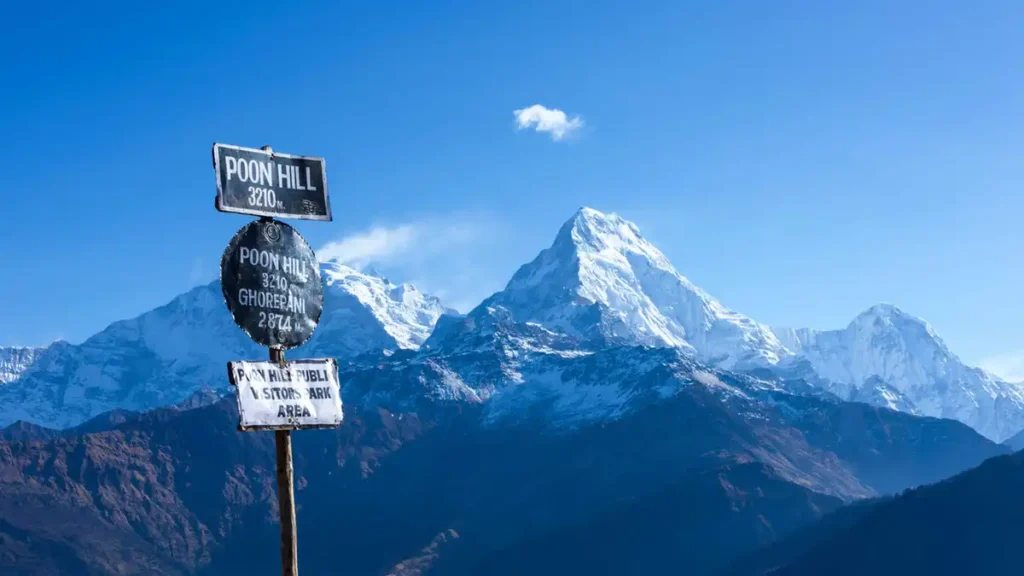
Poon Hill viewpoint delivers a 180-degree panorama of 3 peaks above 8,000 meters: Dhaulagiri (8,167m), Annapurna I (8,091m), and Manaslu (8,163m). The sunrise view from the hilltop attracts 30 to 80 trekkers daily during peak season. Machapuchare (6,993m), Annapurna South (7,219m), and Hiunchuli (6,441m) complete the mountain lineup.
Rhododendron forests between 2,000 and 3,000 meters bloom red, pink, and white during March and April. The forest canopy creates a tunnel effect on the trail ; limiting views during hiking but creating dramatic forest-to-mountain contrasts at viewpoints. Poon Hill concentrates mountain scenery into 1 stunning sunrise moment rather than continuous panoramic exposure.
What You See on the Annapurna Circuit
The Annapurna Circuit delivers mountain views across 12 to 21 days through constantly changing landscapes. Manaslu (8,163m) dominates the eastern skyline from Besisahar to Chame over the first 4 to 5 days. Annapurna II (7,937m), Annapurna III (7,555m), and Gangapurna (7,455m) tower above Manang valley between Day 5 and Day 8.
Thorong La Pass (5,416m) provides 360-degree views of both Annapurna and Dhaulagiri ranges simultaneously ; a perspective unavailable from any other accessible point. The Kali Gandaki valley between Jomsom and Tatopani cuts through the deepest gorge on Earth at 5,571 meters depth between Dhaulagiri and Annapurna.
Which Trek Delivers Better Views
Poon Hill concentrates mountain views into 1 to 2 exceptional moments ; sunrise at the viewpoint and the Ghorepani ridge walk. The Annapurna Circuit distributes views across 12 to 21 days with mountain perspectives changing every 2 to 3 hours of hiking.
Poon Hill wins for efficiency ; delivering world-class views in 4 to 5 days. The Annapurna Circuit wins for depth ; revealing 5 distinct mountain landscapes across 3 weeks. Photographers choosing between Poon Hill or Annapurna Circuit often prefer the circuit for its 10x more shooting opportunities across diverse terrain.
Cultural Experience Comparison
Poon Hill ; Gurung Villages and Rhododendron Forest
Poon Hill Trek passes through 3 to 4 Gurung villages including Ghandruk (1,940m) ; the largest Gurung heritage settlement on the Annapurna trail system. Stone houses with slate roofs, Buddhist prayer flags, and terraced rice fields characterize the Gurung cultural landscape. Trekkers experience 1 primary ethnic culture across the entire 4 to 5 day route.
Annapurna Circuit ; 5 Cultural Zones in 1 Trek
The Annapurna Circuit crosses 5 distinct cultural zones within a single trek ; the highest cultural diversity of any trekking route in Nepal. Hindu lowlands (800m-1,500m) transition to Gurung mid-hills (1,500m-2,500m), then Manangi Buddhist valleys (2,500m-3,500m), Thakali trading towns (2,500m-2,800m), and Mustang’s Tibetan plateau culture (2,800m-3,800m).
Muktinath Temple (3,710m) serves 100,000+ Hindu and Buddhist pilgrims annually ; a sacred site housing 108 water spouts and an eternal flame. Braga Monastery near Manang dates to the 15th century with 400-year-old clay statues. The circuit delivers cultural immersion that Poon Hill’s single-culture experience cannot match.
Cost Comparison ; Budget Breakdown 2026
Poon Hill Total Cost
| Expense | Poon Hill Cost |
| Permits (ACAP + TIMS) | $50 |
| Accommodation (4 nights × $5-10) | $20-40 |
| Food (4 days × $15-25) | $60-100 |
| Guide (4 days × $25-35) | $100-140 |
| Transport (Pokhara-Nayapul return) | $15-25 |
| Gear rental | $15-25 |
| Miscellaneous | $20-30 |
| Total | $280-410 |
Poon Hill costs $60 to $80 per day ; the lowest per-day trekking expense in the Annapurna region. The permits required for both routes cost identical amounts ($50), making permit fees proportionally higher for short Poon Hill treks.
Annapurna Circuit Total Cost
| Expense | Circuit Cost (15 days) |
| Permits (ACAP + TIMS) | $50 |
| Accommodation (14 nights × $5-12) | $70-168 |
| Food (15 days × $15-30) | $225-450 |
| Guide (15 days × $25-45) | $375-675 |
| Transport (Kathmandu-Besisahar + Jomsom-Pokhara) | $30-60 |
| Gear rental | $30-50 |
| Miscellaneous | $40-60 |
| Total | $820-1,513 |
Cost Per Day Comparison
Poon Hill costs $60 to $80 per day while the Annapurna Circuit averages $50 to $75 per day. The circuit provides lower daily cost due to longer duration spreading fixed costs (permits, transport, gear rental) across more days. Total circuit expense runs 200% to 300% higher than Poon Hill due to 3 to 4 times longer duration.
Gear rental costs differ between short and long treks ; sleeping bag rental for 4 Poon Hill nights costs $8 to $12 versus $30 to $45 for 15 circuit nights. Budget trekkers choosing between Poon Hill or Annapurna Circuit save $400 to $1,100 by selecting the shorter route.
Accommodation and Food Quality
Poon Hill Teahouse Standard
Poon Hill teahouses rank among the highest in the Annapurna region. Ghorepani (2,860m) hosts 20+ lodges with heated dining rooms, hot showers, and attached bathrooms. The maximum altitude of 3,210 meters ensures all teahouses receive regular supply deliveries via road-accessible villages.
Menu variety stays consistent at 25 to 35 items including international dishes, fresh vegetables, and meat options. Wi-Fi costs $1 to $2 per day with 1 to 3 Mbps speeds. Poon Hill teahouses operate year-round with 90% to 95% availability during October-November and March-April seasons.
Annapurna Circuit Teahouse Variety
Annapurna Circuit teahouse quality varies dramatically between 760 meters and 5,416 meters. Lodges below 2,500 meters offer comfortable rooms, attached bathrooms, and diverse menus matching Poon Hill standards. Quality peaks in Manang (3,540m) with bakeries, pizza restaurants, and heated lounges.
Quality drops sharply above 4,000 meters ; Thorong Phedi (4,525m) and High Camp (4,850m) provide basic rooms with thin walls, shared squat toilets, and 8 to 12 item menus. Temperatures at these high camps reach -15°C to -20°C overnight with no heating systems. The accommodation swing from comfortable lowland lodges to spartan high-altitude shelters creates the circuit’s unique character.
Best Season for Each Trek
Poon Hill performs well across 8 months (October-May) with only June-September monsoon creating poor conditions. March and April deliver rhododendron blooms unavailable during autumn season. December and January bring cold temperatures at Ghorepani but safe trekking conditions without snow on the trail.
The Annapurna Circuit requires more specific timing ; October and November deliver the safest Thorong La crossing conditions with clear skies on 80% to 85% of days. March and April provide the second-best window but with 20% to 25% higher afternoon cloud coverage above 4,000 meters. December through February closes Thorong La Pass on 40% to 60% of days due to heavy snowfall.
Seasonal weather patterns across the Annapurna region affect the circuit more dramatically than Poon Hill due to the 2,200-meter altitude difference between maximum elevations. Trekkers exploring when to begin planning for peak season availability find circuit bookings require 2 to 3 months advance planning versus 2 to 4 weeks for Poon Hill.
Who Should Choose Poon Hill
Best for Beginners and Short Vacations
Poon Hill suits trekkers with 5 to 7 days total in Nepal including Kathmandu sightseeing and travel days. Zero previous trekking experience proves necessary ; the well-marked trail below 3,210 meters presents minimal physical or altitude risk. The Nepal Tourism Board promotes Poon Hill as Nepal’s most accessible Himalayan trek for international visitors.
Best for Families and Older Trekkers
Families with children aged 10+ and adults over 60 complete Poon Hill safely with standard 4 to 5 day itineraries. The maximum altitude stays 290 meters below the 3,500-meter altitude sickness threshold. Safety levels that make both treks suitable for international visitors confirm Poon Hill as the lower-risk option for families and first-timers choosing between Poon Hill or Annapurna Circuit.
Who Should Choose the Annapurna Circuit
Best for Experienced Trekkers
Trekkers with 2+ previous multi-day treks and 14 to 23 days available unlock the circuit’s full potential. Prior experience above 3,000 meters reduces altitude sickness risk at Thorong La by 30% to 40%. The physical demands of 12 to 21 consecutive trekking days require cardiovascular fitness built through 8 to 12 weeks of preparation.
Best for Cultural Immersion Seekers
Trekkers prioritizing cultural diversity over mountain views alone choose the circuit for its 5 ethnic zones, ancient monasteries, and sacred pilgrimage sites. The 12 to 21 day duration creates relationships with teahouse families, guides, and fellow trekkers impossible during a 4-day Poon Hill trip. First-timers wondering whether they handle the circuit with proper preparation find that motivation and adequate training matter more than previous experience.
Can You Combine Both Treks?
Combining Poon Hill and the Annapurna Circuit creates a 16 to 26 day itinerary covering both experiences. Trekkers complete Poon Hill first (4-5 days) for acclimatization and confidence building before starting the circuit. The 3,210-meter Poon Hill altitude pre-acclimatizes the body for the circuit’s gradual climb toward 5,416 meters.
The combined itinerary adds $200 to $400 for the Poon Hill section to circuit costs. Trekkers with 3 to 4 weeks available in Nepal maximize mountain views, cultural exposure, and trekking variety through this combination. Permit costs remain identical ($50 total) since both treks operate within the same ACAP zone covered by 1 permit set.
Conclusion
Poon Hill or Annapurna Circuit ; the right choice depends on 3 factors: available time, budget, and trekking ambition. Poon Hill delivers world-class Himalayan sunrise views within a 4 to 5 day window at $280 to $410, making it the most accessible mountain experience in Nepal for beginners, families, and time-limited travelers.
The Annapurna Circuit demands 12 to 21 days and $820 to $1,513 but rewards with 5 cultural zones, the world’s deepest gorge, a 5,416-meter pass crossing, and mountain panoramas that change every few hours across 3 weeks of walking. Trekkers with the time and fitness for the circuit experience something Poon Hill cannot replicate ; the transformation that happens when mountains become your home for 2 to 3 weeks straight.
FAQs
Do Poon Hill and the Annapurna Circuit require different permits?
Both treks require identical permits ; ACAP permit ($30) and TIMS card ($20) totaling $50 per person through the Nepal Department of Immigration. The same permit set covers both routes since Poon Hill falls within the Annapurna Conservation Area boundary. Trekkers combining both treks use 1 single permit set for the entire duration.
Is Poon Hill worth it if I plan to do the Annapurna Circuit later?
Poon Hill provides excellent standalone value with sunrise views of Dhaulagiri (8,167m) and Annapurna I (8,091m) unavailable from the standard Annapurna Circuit route. The circuit passes through the opposite side of the Annapurna massif, showing different peaks from different angles. Completing both treks delivers complementary experiences rather than repetitive mountain views.
Can beginners do the Annapurna Circuit instead of Poon Hill?
Beginners with strong cardiovascular fitness and 14+ days complete the Annapurna Circuit safely using 18 to 21 day itineraries with proper acclimatization. The key requirement involves 2 to 3 acclimatization days in Manang (3,540m) before attempting Thorong La Pass. Beginners without fitness preparation face 40% higher exhaustion and altitude sickness rates compared to trained trekkers.
Which trek has better food options?
Poon Hill teahouses serve 25 to 35 menu items with fresh vegetables, meat, and international dishes throughout the 4 to 5 day route. The Annapurna Circuit offers similar variety below 2,500 meters but reduces to 8 to 12 basic items above 4,000 meters near Thorong La. Poon Hill wins on consistent food quality while the circuit wins on food variety across its 5 cultural zones.
Is the Annapurna Circuit safe for solo trekkers?
Nepal government regulations effective from 2023 require all Annapurna Conservation Area trekkers to hire licensed guides ; solo permits are no longer issued. Guide-accompanied trekkers show 60% lower incident rates compared to pre-2023 solo trekking data. Both Poon Hill and the circuit maintain identical guide requirements.